
In the previous article (The newest PR and Comms launchpad emerges), we realized ‘Polarisation’ to be the new factor of traction in PR and Comms.
The USC Annenberg School of Communication and Journalism, in its 11th annual USC survey (2026), finds a “quiet shift” in public relations as “polarization reshaping corporate speech.” Polarisation takes place when issues (especially sensitive issues) are debated and are in public dialogue, and then disagreement results.
What is the key challenge for PR and Comms industry in the ‘Age of Polarisation’? The challenge is to ‘find the direction of corporate PR’.
And then what are the staple corporate PR priorities that are mostly talked of today? The list is not unexpected: Data-Driven PR, reputation management, storytelling, influencer engagement.
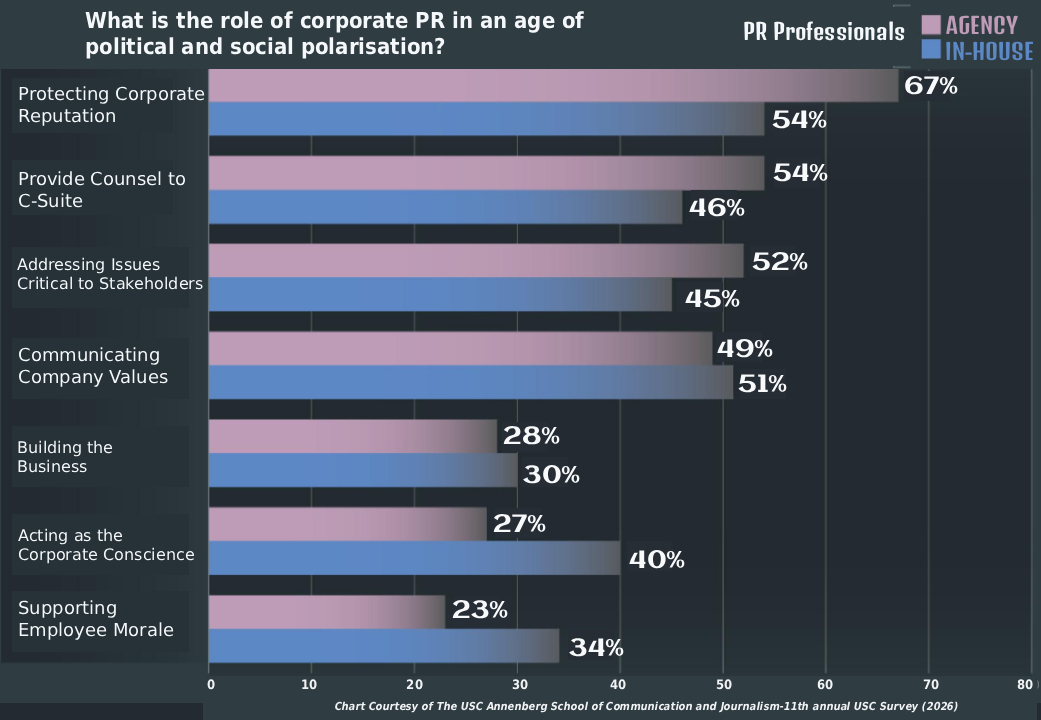
On the other hand, as the chart indicates, the 11th annual USC survey (2026) found a slightly different ‘mix’ of priorities.
PR professionals in both ‘agency’ and ‘in-house’ segments appeared to share broadly similar views. ‘Protecting corporate reputation’ led the list, followed by ‘providing counsel to C-Suite’. ‘Addressing stakeholder concerns’ came third, followed by ‘communicating company values’. Given that ‘communicating company values’ is a pronounced way of communicating ‘polarisation’ as well, and given the quiet shift from polarisation, it’s apt that ‘communicating company values’ is ranked lower in the hierarchy.
In that, at present, brand management and governance related factors receive higher priority, while operational/execution related factors are of low priority.
What does this mean?
It is a wake-up call…
“Preserving the brand and building brand equity is just fine… but the immediate call to action for PR is the clients’ RoI..Start switching from messaging and brand risk control to YJR marketplace: Marketing and lead generation.”
That’s a much needed reality check for the industry.