
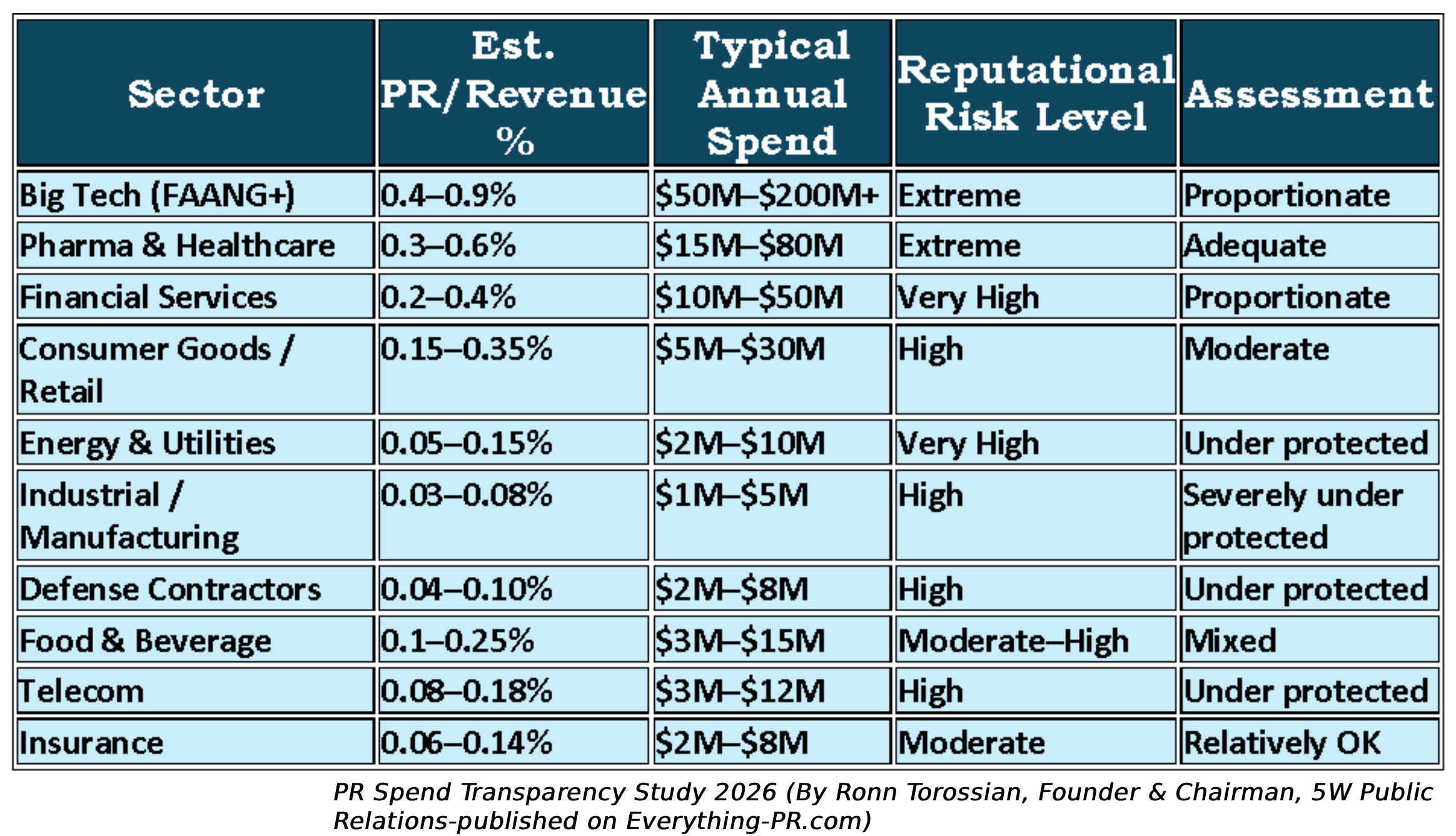
Companies in sectors that are highly exposed and deemed to need PR spend the least on PR.
Sectors that we believe are spending less on PR spend the highest.
And 71% Fortune 500 companies do not disclose their PR spend!
These are just a few findings from the ‘PR Spend Transparency Study 2026’ (By Ronn Torossian, Founder & Chairman, 5W Public Relations, published on Everything-PR.com), a systematic analysis of how Fortune 500 companies actually budget for their public relations.
The new study offers an unprecedented peek at how the world’s largest corporations allocate their PR budget.
In 2019, the team at ‘10 Yetis’ conducted a study as part of research on ‘how brands view PR’ (‘Insight: Study reveals which industries utilise public relations the most and least – 10 Yetis’ published by Harriet Cramer on June 18, 2019, at https://fieldmarketing.com). The more than 600 businesses that took part in the 2019 study were not necessarily Fortune 500 corporates (as in the 2026 Study), but still were active in the same sectors.
The ranking order of PR allocations for different sectors in the 10 Yetis study of 2019 contrasts significantly with the sector rankings of 2026’s Fortune 500 spend.
The 2019 study’s highest ranked sector was FMCG (Food & Drink), while the 2026 study’s highest ranked sector was Big Tech.
Second ranked in the Yeti study was Fashion, but in the second rank in 2026 is ‘Pharma and Healthcare’. The third in 2019 was Technology (2026-Financial Services), fourth, Healthcare (2026-Consumer Goods/Retail), fifth, ‘Insurance ‘ (2026-Energy and Utilities), sixth in 2019 was Travel (2026-Industrial/Manufacturing), seventh, Pharmaceutical (2026-Defence Contractors), eighth, Automotive (2026-Food and Beverage), ninth, Hair and Beauty (2026-Telecom), and tenth, Financial services (in 2026-Insurance).
The Editorial Team at everything-pr.com states (at https://everything-pr.com/pr-spend-transparency-study-2026/) of three very important practical implications that emerge from the 2026 Study Data.
Firstly, the importance of sectors of operation: “Benchmarking against general marketing averages is the wrong comparison; sector-specific reputational exposure must be the baseline.”
Secondly, underinvestment in PR by companies costs more, eventually, when a reputational crisis hits, as a sudden crisis retainer costs more than regular, sustained PR work.
Thirdly, many corporates (in Fortune 500, that is) are not being transparent about their PR results, and stakeholders are not able to assess the comms infrastructure. “As ESG and stakeholder capitalism frameworks expand, this gap is likely to attract scrutiny,” states everything-pr.com’s Editorial Team.
The Editorial Team’s first recommendation, “sector-specific reputational exposure must be the baseline”, drives home an important lesson for PR.
The company/brand is affected immediately by what happens in its industry. The company cannot escape from changes in the industry, as such changes permeate the company. The PR, therefore, should be proactive and continuously ongoing. The PR approach should not be some ‘residual part’ of the marketing budget, which, if it happens, (unavoidably) exposes the company to reputational risk!
…be it (the Company) a Fortune 500 brand…or not!