- Did President Xi really ban Chinese influencers?
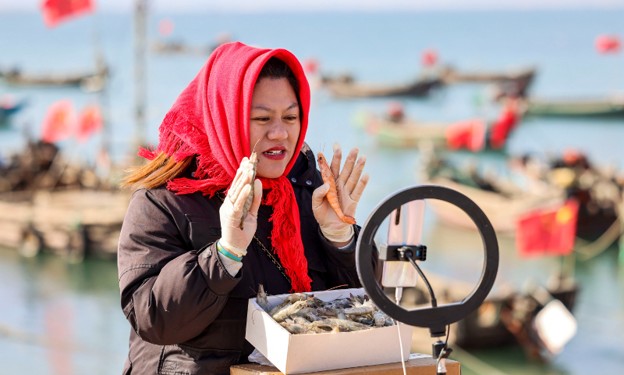
A Chinese streamer shows local prawns to consumers through livestreaming at a port in Dongshanzhang village, East China’s Shandong Province, on February 14, 2023. Photo Courtesy: Global Times- Sep 03, 2023
The internet and social media space were recently taken by storm with posts claiming that Chinese President Xi Jinping had announced the banning of social media influencers “without a degree” and influencers “not to flaunt wealth”.
… except that President Xi Jinping did not make any such announcement-ever.
Though President Xi spoke in general on regulating chaos in the Chinese fan culture and entertainment industries way back in 2021, he never directly issued a Presidential Decree to this effect.
What happened?
The Chinese government under President Xi Jinping’s leadership has introduced regulations on the “livestreaming” and “entertainment” sectors starting in 2022. This was implemented through the Cyberspace Administration of China (CAC) and the Ministry of Culture and Tourism (MCT). These regulations aimed at enforcing compliance, protecting minors, and reducing tax evasion (on high earning influencers who flaunted their wealth on screen).
Prior to the new rules, the multi-billion dollar Livestreaming sector was being plagued by “virtual tipping” and a lack of strong ‘Financial Controls.’ Audience, especially minors under age 18, were recklessly buying ‘virtual gifts’ and performing “virtual tipping” to influencers (spending their parents’ money on ‘digital token gifts’ to content creators). Also, influencer fan clubs (known as ‘Fan Quan’) were growing -and started to behave as if large corporations!
Starting April 2022, the Cyberspace Administration of China (CAC) introduced “Qinglang Campaign,” a multi-agency “internet governance initiative” focusing on ‘disciplining’ not only the chaotic influencer segments but even the internet providers -Tencent, ByteDance, and Sina Weibo.
What are the rules on educational and professional qualifications?
They were issued by Chinese official regulatory agencies and NOT by the Chinese President.
The national agencies were China’s National Radio and Television Administration (NRTA), the Ministry of Culture and Tourism, and the Cyberspace Administration of China.
The new regulations did not say that all influencers “must have a university degree.”
They asked that content providing influencers who talk about specific professional topics possess the “relevant/corresponding professional qualifications” or “licenses”- specifically, influencers in three core sectors: Law, Medicine/Health and Finance. Thus, a general ‘lifestyle influencer’ (say, an influencer on cooking, travel, or gaming…) is NOT required to hold a university degree or license to stream!
While there was no Presidential Decree, the government, supporting the well-known “Common Prosperity” theme, has initiated forward looking action. The “Common Prosperity” concept leads to such important social ideals as “reduction of inequality” and “preventing chaotic expansion of capital”.
With due respect to influencers and their messaging efficacy, this event may have important lessons for economies that sometimes complain of “toxic-influencer fandoms.” Mature judgement by the influencers and the audience on the content used is needed more now than ever!